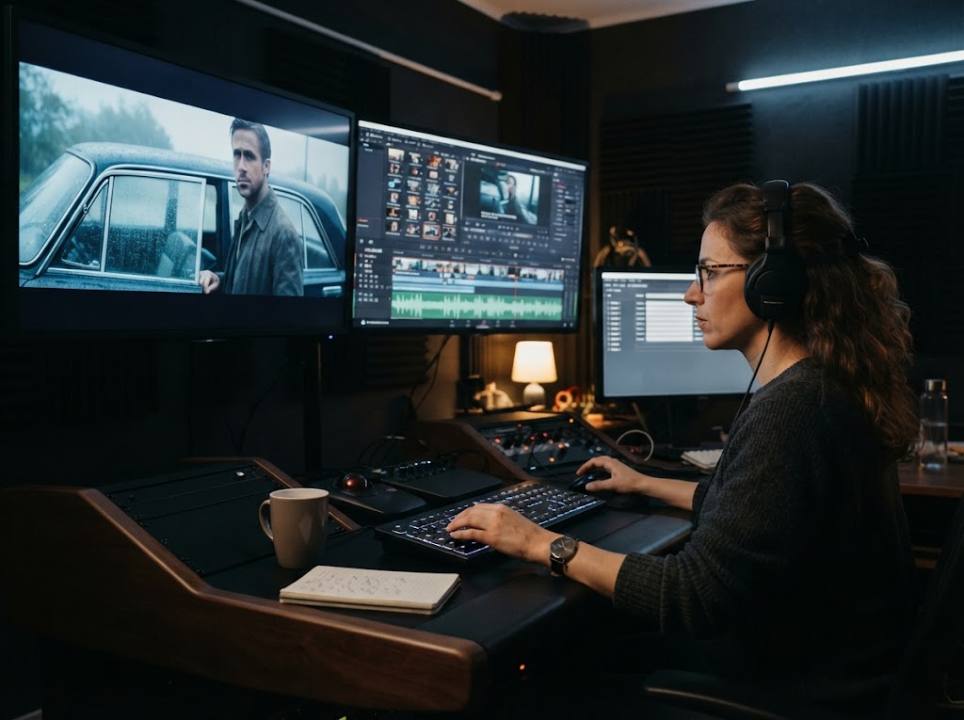
Video content has exploded. Companies produce training videos, product demos, webinars and social clips. Streaming platforms release series in dozens of languages at once. E-learning providers publish entire course libraries. All of it needs subtitles, dubbing scripts or voice-over translations, usually on tight deadlines.
What many people do not realise is how much video content repeats. Recurring phrases, product names, intros, outros and on-screen text appear again and again, which makes translation memory software surprisingly valuable in audiovisual translation.
Where the Repetition Comes From
A corporate training series might use the same greeting, the same safety disclaimer and the same closing call to action in every episode. A software tutorial library repeats menu names and interface terms constantly. A drama series has recurring character names, catchphrases and locations. Translation memory stores every approved subtitle line, so these repetitions are translated once and reused with confidence.
Consistency Viewers Notice
Viewers notice when a character's nickname is translated differently in episode three, or when a product feature has two names in one course. Memory and terminology databases keep these details consistent across episodes, seasons and even across dubbing and subtitle versions. For brands, consistent terminology in videos reinforces the same language used on websites and in documentation.
Subtitles Have Their Own Rules
Subtitles are constrained by reading speed, line length and timing. A good subtitle is short, readable in a few seconds and synchronised with speech. Industry style guides, such as the Netflix partner timed text guidelines, set detailed rules for characters per line, reading speed and formatting in each language. Translation memory must work alongside these constraints, suggesting previous translations while still letting the subtitler condense or rephrase where needed.
Scripts and Voice-Over
For dubbing and voice-over, translators work on scripts that must match lip movements or timing. Here, memory helps with recurring lines and terminology, while creative adaptation remains a human task. Storing approved scripts also helps when a video is updated and only a few scenes change.
On-Screen Text and Graphics
Videos often contain text in graphics, lower thirds, titles and animations. These elements are easy to forget. Extracting them into the same translation project, with the same memory and glossary, ensures they match the subtitles and the spoken content.
Choosing Memory Translation Software for Video
- Support for subtitle formats such as SRT and VTT, and for scripts in common document formats
- Character counting and length limits per line
- Shared memories and glossaries across projects and seasons
- Quality checks for timing-related issues, numbers and names
- Cloud access for distributed subtitlers and reviewers
Many teams manage video localization inside a broader TMS tool, so video, website and documentation translations share the same assets. Wordbeam's translation memory software is one example of a platform where memories and terminology are shared across all content types.
A Practical Workflow
A typical workflow starts with the transcript or source subtitle file. The project manager imports it into the translation platform, where memory matches from previous episodes or courses are applied automatically. Subtitlers then translate the remaining lines, checking each against timing and reading-speed limits. A reviewer watches the video with the translated subtitles, fixing any line that feels too long, too literal or out of sync. Approved lines are saved back to memory for the next episode. Over a season or a course library, the proportion of reused lines grows steadily, and so do the savings.
Accessibility Matters Too
Subtitles are not only for foreign audiences. Captions for deaf and hard-of-hearing viewers, including sound descriptions, are increasingly required by law and expected by audiences. Translating these accessibility captions into other languages follows the same principles, and the same memory and glossary can support them. Treating accessibility and localization as one process saves effort and ensures that every viewer gets a consistent experience, whatever language they watch in.
Measuring the Benefit
Most platforms report how many words or lines were matched from memory on each project. Tracking these numbers over time shows exactly how much faster and cheaper each new episode or course becomes.
Human Skill Still Leads
Translation memory speeds up repetition, but subtitling is a craft. Humour, wordplay, cultural references and emotional nuance need a skilled audiovisual translator. Memory supports that work by removing the repetitive part, not by replacing judgement.
Multilingual Video Programmes
Global companies often subtitle training content in many languages at once. A course produced in English might need German for European staff and Ukrainian for teams in Eastern Europe. Working with professional German translation services and qualified Ukrainian to English translation specialists, all connected to the same memory and glossary, keeps every version aligned.
The Takeaway
Video translation is repetitive in ways that are easy to overlook. Translation memory turns that repetition into speed, lower costs and consistent terminology, while skilled subtitlers focus on making every line feel natural on screen.